Stop Documenting Everything for Your Family Court Case
You've got the folder. Or the plastic crate. Or the seventeen-tab spreadsheet you built at 2am because you couldn't sleep and just needed to do something.
Every text. Every late pickup. Every "tone" in an email.
Every time they forgot the water bottle, showed up in the wrong shoes, or said something slightly off to the kids.
Or maybe it's worse...
Every ER visit with bruises or other injuries.
Every disclosure about sexual harm.
Every tearful, whispered moment you've managed to record when your child tells you something they can barely put into words.
You've documented all of it. Because someone, somewhere, told you "document everything," and you took that instruction and ran with it like your case depended on it. And they were right... sort of.
But here's the uncomfortable part: the way you're doing it might actually be working against you.
Why? Because documenting everything means nothing will stand out.
The Logic That Feels Right But Isn't
"Document everything" sounds like solid advice. And in a way, it is, because the decision to keep clear factual records instead of relying on your exhausted brain-foggy memory is a good one.
But there's a difference between documenting thoroughly and drowning your case in undifferentiated data.
When every single interaction gets flagged as evidence, equally weighted, equally urgent, equally "see, THIS is what I deal with"... then nothing stands out anymore.
The late pickup sits next to the missed medication next to the slightly snippy text next to the actual safety concern, all formatted the same, all treated with the same level of alarm.
To you, it's all connected.
It's all part of the pattern you've lived through for years.
And you're not wrong.
But to an attorney, judge, or evaluator skimming a 40-page printout at 11pm before your hearing?
It reads as noise.
It reads as chaotic, panicky, and controlling.
And chaotic noise is easy to dismiss.
Why This Happens (and Why It's Not About Being Disorganized)
This isn't a discipline problem. Most protective parents who are documenting like this are anything but disorganized, (in fact, in my observation they're often the most detail-oriented person in the room!)
It's often something else entirely: hypervigilance.
If you've lived through a dynamic where small things escalated into big things without warning, where you had to catch every detail because missing one felt dangerous, then of course everything feels flag-worthy now! Your nervous system learned that not noticing something was a huge risk to take.
That instinct kept you safe once.
It may not be serving your case now.
In fact, it may be actively sabotaging your outcomes in court.
What This Actually Costs You
An overloaded record can quietly work against you in a few ways:
Credibility gets diluted. If everything is "a big deal," reviewers start to wonder if you can tell the difference between a real risk and a bad day.
Real issues get buried. The actual safety concern is sitting on page 23, sandwiched between minor entries about rescheduling the kids' little league practice.
You look reactive instead of strategic. A stack of undifferentiated grievances can read as "keeping score" rather than "proving a pattern."
None of this means your concerns aren't actually valid. It just means the format you're using may be working to obfuscate the dangerous facts you're trying to showcase.
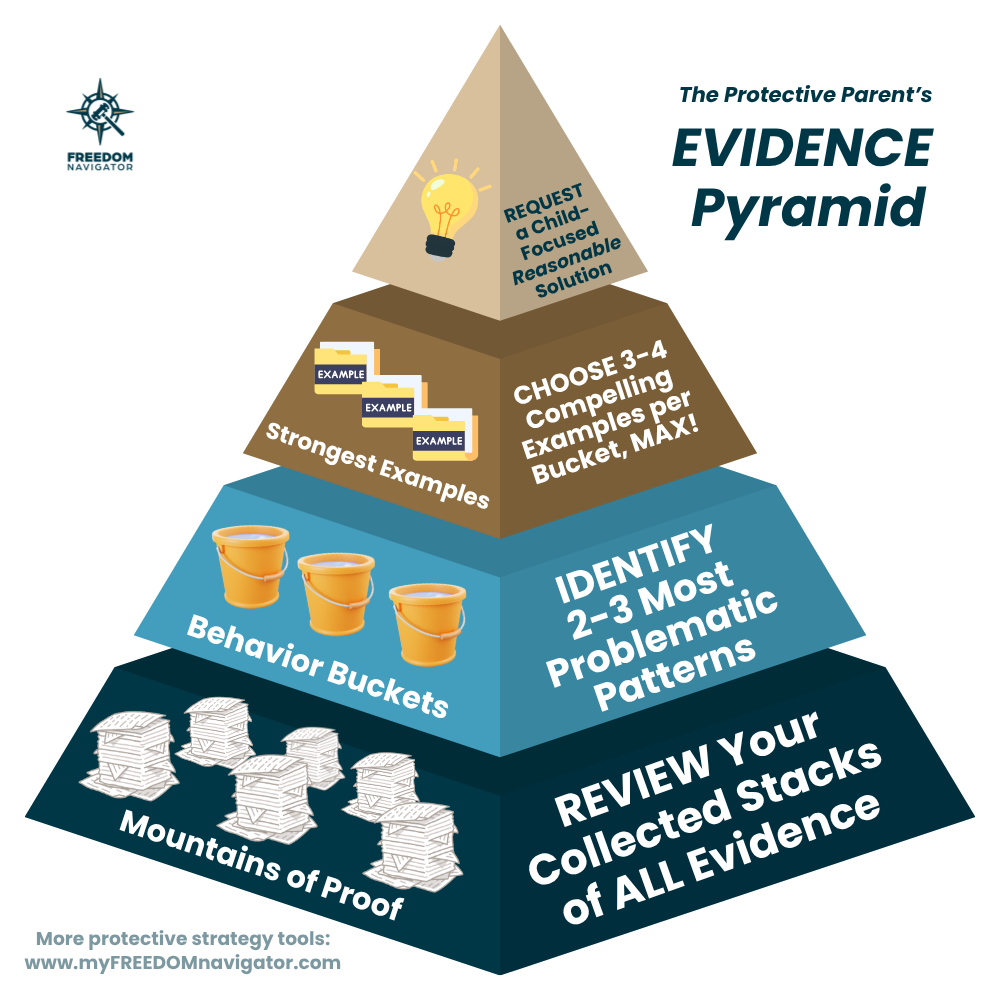
Use the Evidence Pyramid to Organize Evidence More Effectively
Sort before you submit. Not everything needs to go in front of a judge. Some things just need to exist, quietly, in your own records, in case a pattern develops later.
Separate safety issues from friction issues. A missed pickup and a safety concern are not the same category, and they shouldn't be treated the same on paper.
Ask "does this show a pattern, or is this just annoying?" Annoying is real. It's just probably not actionable.
Use dates, facts, and outcomes, not narration. "3:47pm, not present at pickup, no contact until 4:45pm" does more work than any paragraph about how it made you feel.
Build your record like someone else will read it cold. Because they will. And it'll most likely be someone with zero background, 7 minutes, and a massive stack of other cases.
Let the patterns speak for themselves.
Don't narrate, diagnose, or provide conclusions for them.
The Bigger Picture
Effective documentation isn't about proving how bad the other parent is, or even that you're the more careful parent. It's about giving a complete stranger with limited time (and even less context) - judge, evaluator, attorney - a clear, credible, weighted picture. Doing this requires clear, self-explanatory data points, not copious amounts of history.
You're not crazy. You're just trying to survive a system that rewards structure over volume.
for your freedom, Sarah

Pssst! You don't have to figure out what's worth documenting through trial and error.
👉 The Ultimate BINDER for Divorce + Custody was built exactly for this: a structured system for organizing evidence so what matters actually stands out, instead of getting lost in what doesn't. 100+ pages of printable pages, plus adaptable trackers and log sheets, plus super-simple step-by-step tutorials...
...because a smart protective parent keeps the receipts, the right receipts, organized the right way.
Need more hand-holding to know what counts as pattern-worthy vs. noise? Get personal, weekly live calls and expert tactical guides to navigate the court system in BASECAMP, a monthly membership that provides coaching, community, and court-ready tools for protective moms navigating high-conflict custody battles.