Will My Divorce Turn High-Conflict?
If you’re standing at the edge of separation or divorce after surviving harm in your marriage — whether that harm looked like physical abuse, coercive control, chronic betrayal, intimidation, or emotional trauma — there’s a particular kind of fear that can settle in your chest
It’s not just “Will this be hard?"
You already know it's gonna be hard... it's probably been hard for a long time now.
If you've been living with broken trust and fear of retaliation, if you've been holding anxiety tighter than your pillow every night, calculating mental math on the pros and cons of every possible pathway forward... then I'm writing to you right now.
You may be wondering:
Will my divorce be one of the ones that drags on for years and drains everything I have?
Will my ex stay reasonable once I set boundaries, or will they escalate conflict to keep control?
Am I at risk for post-separation abuse?
How can I possibly know what’s coming — or prepare for it — without spiraling into fear?
These questions may feel intense, but if you've been learning anything about the process of rebuilding after a harmful marriage then you already know they're things you've got to ask. It's not pessimistic to ponder the variables before you take action.
These are the questions of someone whose nervous system has already learned, the hard way, that behavior patterns matter.
And here’s the truth most people won’t say out loud: some family court cases get labeled "high-conflict" not because both people are equally petty, but because separation disrupts your compliance with their control.
That doesn’t mean you're doomed. But it does mean that it's wise to take the time to more clearly understand your risk. Doing this in an effective way doesn't have to mean you're paranoid, it just means you're taking extra caution as an act of self-protection.

Why “High-Conflict” Isn’t Always About Being Difficult
When people hear the phrase high-conflict court case, they often imagine two people who just can’t get along, or a messy breakup fueled by mutually vindictive bitterness. In fact, many judges and attorneys and other court-appointed professionals tend to make exactly that assumption.
Instead of recognizing and addressing the patterns of persistently repeated harmful behavior, they assign "co-parenting classes" or throw up their hands and say "you two just need to get along!"
But protective parents are often dealing with dynamics that go much deeper, dynamics like coercive control, abuse of power, veiled threats, domestic violence by proxy (where one parent hurts the kids in order to punish the other parent), and more. And it's a sad but unavoidable fact that the family court system has a lot to learn about recognizing the red flags of abuse.
So instead, they label it "high-conflict."
High-conflict cases often involve:
One party who struggles with accountability or loss of control
A history of power imbalance or intimidation
Patterns of retaliation when boundaries are enforced
Escalation after separation rather than relief
For survivors of relational harm, separation can be the season when unsafe dynamics don’t end—they just shape-shift. And that is why so many protective parents feel blindsided. They assumed leaving would de-escalate things. Instead, the conflict intensified.
Understanding this risk requires recognizing that past behavior under stress is often more informative than promises made during moments of manipulative calm.
Another way to put it:
The best predictor of the future, is the behavior pattern of the past.
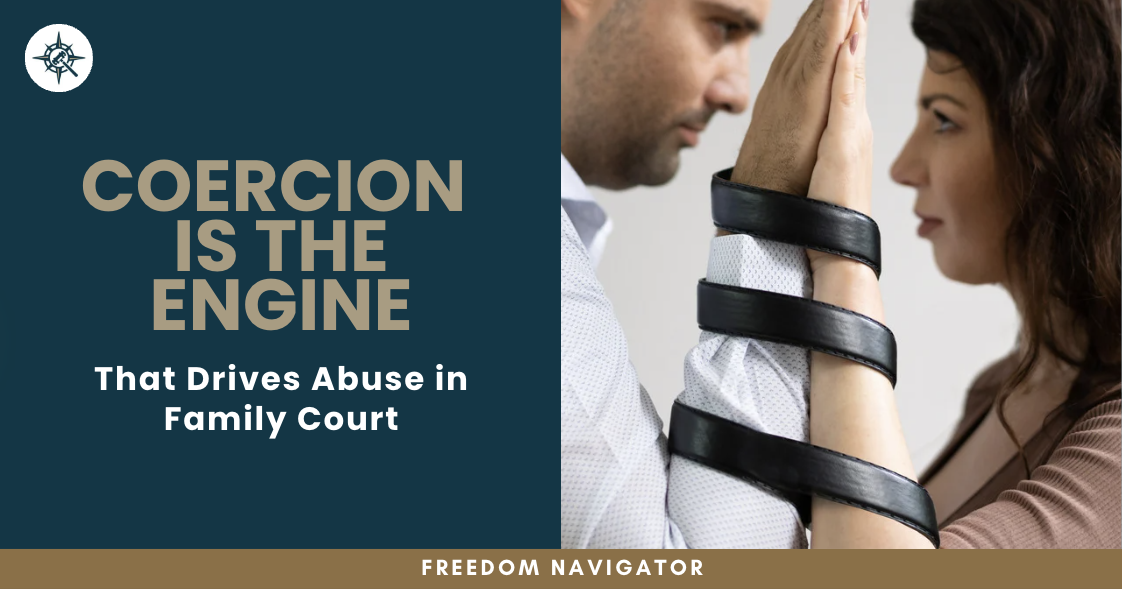
Navigating the Unbearable
One of the hardest parts of this season is the unbearable uncertainty. You may desperately want to know:
Will this take months—or years?
Will my co-parent cooperate—or sabotage?
Will the system protect my children—or misunderstand what’s happening and blame me for seeking safety?
No ethical professional can give you exact answers in advance. (And anyone who claims they can is selling certainty where no certainty exists.)
What is possible, though, is to assess risk factors. Not to predict the future. Not to label your ex a "narcissist." But to help you understand:
whether certain dynamics are present,
whether escalation is more or less likely,
and what level of preparation and support may be wise.
This is exactly why the High-Conflict Court Case – Risk Index (HCC-RI) exists.
What the High-Conflict Court Case – Risk Index Is (and Isn’t)
The HCC-RI is a reflective assessment designed specifically for protective parents who have experienced harm and are contemplating separation or divorce.
It is not:
a diagnosis,
a legal prediction,
or a declaration of what your case “will become.”
It is:
a structured way to look at known risk patterns,
a tool to help you name dynamics you may already feel but haven’t been able to articulate,
and a starting point for thoughtful, grounded preparation rather than reactive fear.
Many survivors minimize their own experiences because they’ve been conditioned to do so. Others over-brace, assuming disaster is inevitable.
This assessment is designed to gently interrupt both extremes.
Having Language for Risk Can Be Regulating
There’s something powerful about moving from vague dread to validated awareness. When risk remains unnamed, your nervous system fills in the blanks... quite often with brain loops that replay catastrophic stories you've heard about how bad court can be. If this leaves you frozen or overwhelmed... you're experiencing a normal trauma response.
However, when risks are identified thoughtfully you can move forward with a stronger sense of clarity and empowerment. This means:
you can slow down,
make informed choices,
and begin planning strategic support instead of constantlybracing for impact.
For many protective parents, simply seeing their experience reflected in neutral, objective terms brings a surprising sense of steadiness.
“I’m not crazy.”
“This isn’t coming out of nowhere.”
“There’s a reason my body is constantly on alert.”
One important thing to know: you don’t have to interpret your results alone. In fact, it's ideal to:
bring your HCC-RI results to your therapist (if they're unfamiliar with it, they can access the HCC-RI Provider Scoring and Interpretation Guide here),
use them as part of safety planning conversations,
and explore what additional supports might help you feel more resourced and grounded.
This isn’t about proving anyone wrong, or giving up on your case if your risk score is on the higher end. It’s about helping the professionals in your corner understand the terrain you may be navigating, and giving yourself the gift of objective validation of reality, so you can feel better about trusting your gut.
You’re Allowed to Prepare Without Assuming the Worst
There’s a quiet grief many protective parents carry—the deep, anguished longing that things could stay calm, that separation could be peaceful, that co-parenting will be collaborative.
Taking a risk assessment doesn’t mean giving up that hope. It just means honoring the part of you that has learned to pay attention to patterns, instead of blindly believing empty promises.
You can:
hope for cooperation,
prep for complexity,
and still stay anchored in compassion for yourself.
These things don't have to be treated as opposites.
Take the Next Gentle Step
If these questions have been circling your mind late at night…
If you feel torn between “Maybe it’ll be fine” and “What if it gets worse?”…
If you want clarity without alarm… then you need to do this:
Step One: complete the High-Conflict Court Case – Risk Index here.
Take it slowly. Answer honestly. Discuss the results with a professional
And remember: the goal is not certainty—it’s awareness.
Step Two: explore court-navigation tools for your risk level.
Once you’ve reviewed your HCC-RI results, it can be tempting to either rush into action, or you may freeze entirely. Both responses make sense when you're experiencing trauma. When you’ve already lived through harm, your system is trying to protect you from more.
This step is about choosing the right level of support for where you are, and for the risk patterns you may be facing. Different risk levels call for different kinds of preparation. What matters most is that you don’t have to figure this out alone, and you don’t have to wait until things escalate to get grounded support.
Here are a few ways protective parents often begin navigating more intentionally:
If You’re Early in the Process or Seeking Orientation
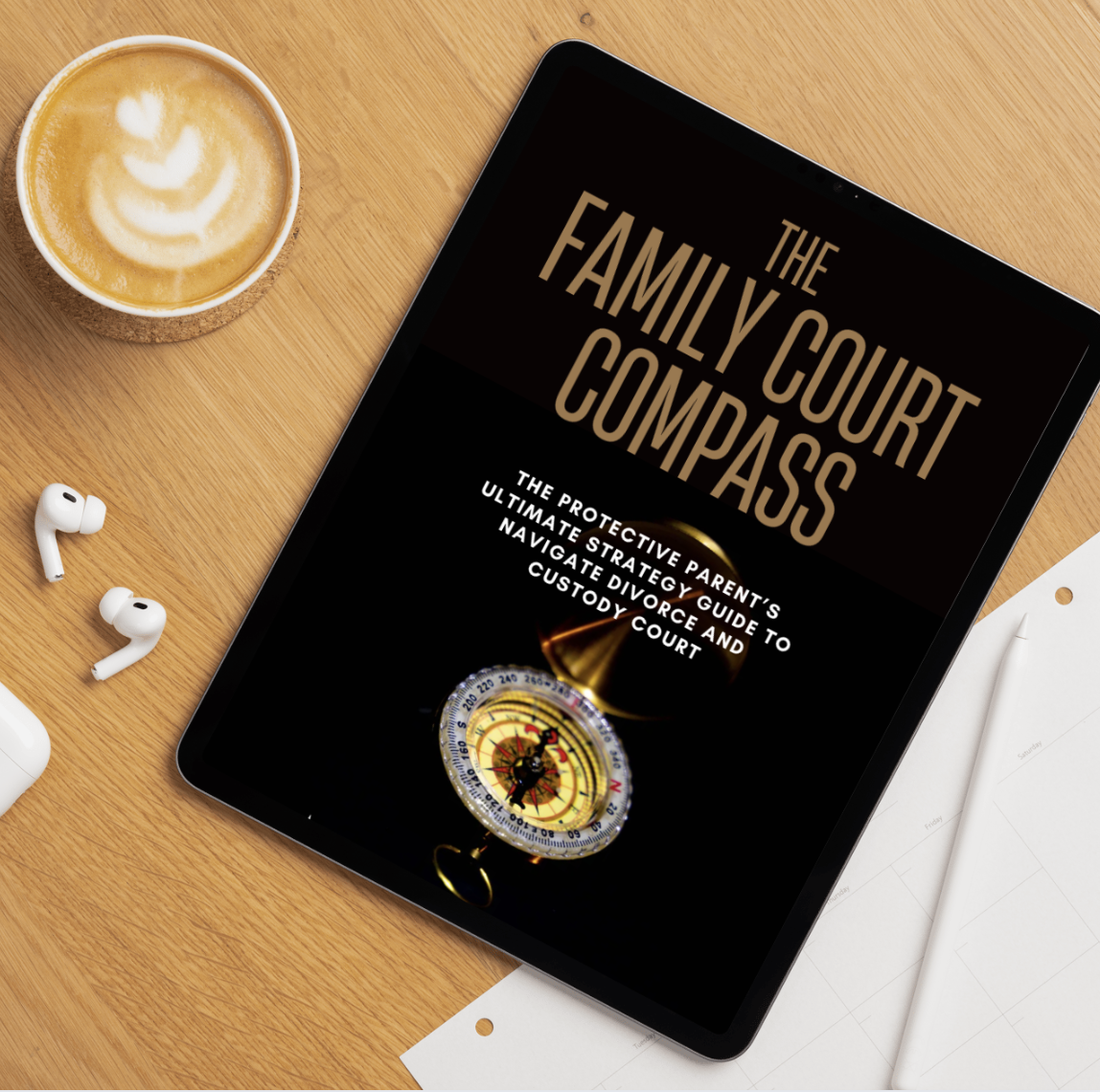
If you’re still wrapping your mind around how family court actually works—and why truth alone doesn’t always carry the day—starting with court literacy and mindset support can be stabilizing.
Tools like the Family Court COMPASS strategy guide can help you understand the realities of the system, shift out of the emotional whiplash, and begin thinking strategically rather than reactively. Many parents use it as a steadying anchor while they decide their next steps.
If Documentation and Organization Feel Overwhelming
For parents whose risk results suggest potential escalation, documentation discipline often becomes essential—not because you’re expecting the worst, but because clarity protects credibility.
The Ultimate Divorce Evidence Binder System was designed for foggy, exhausted brains that still need to “keep the receipts.” It gives you a simple, structured way to track what matters, without turning your life into a full-time case file.
If You Want Ongoing Support Without 1:1 Intensity
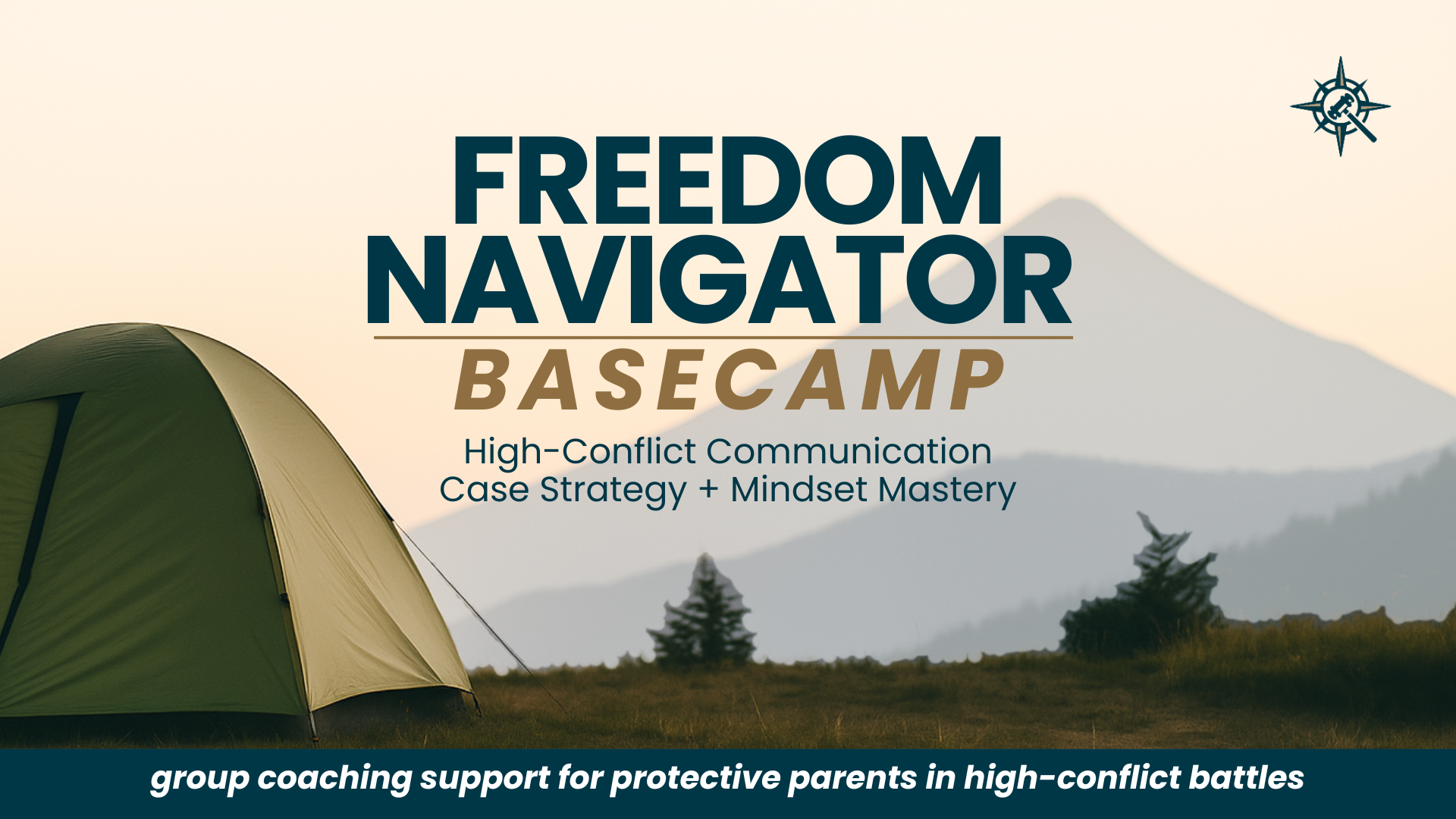
Some parents desperately need consistent guidance, community, and tactical tools, but aren’t ready (or can't afford) individualized coaching.
That’s where BASECAMP can be helpful. It functions as a survival hub with weekly trauma-informed COMPASS Clinics, on-demand tactical guides, evidence organization templates, and a community of other protective parents who get it. BASECAMP is the bridge between strategic awareness and confident action.
If Your Risk Level Suggests Severe Complexity or Escalation
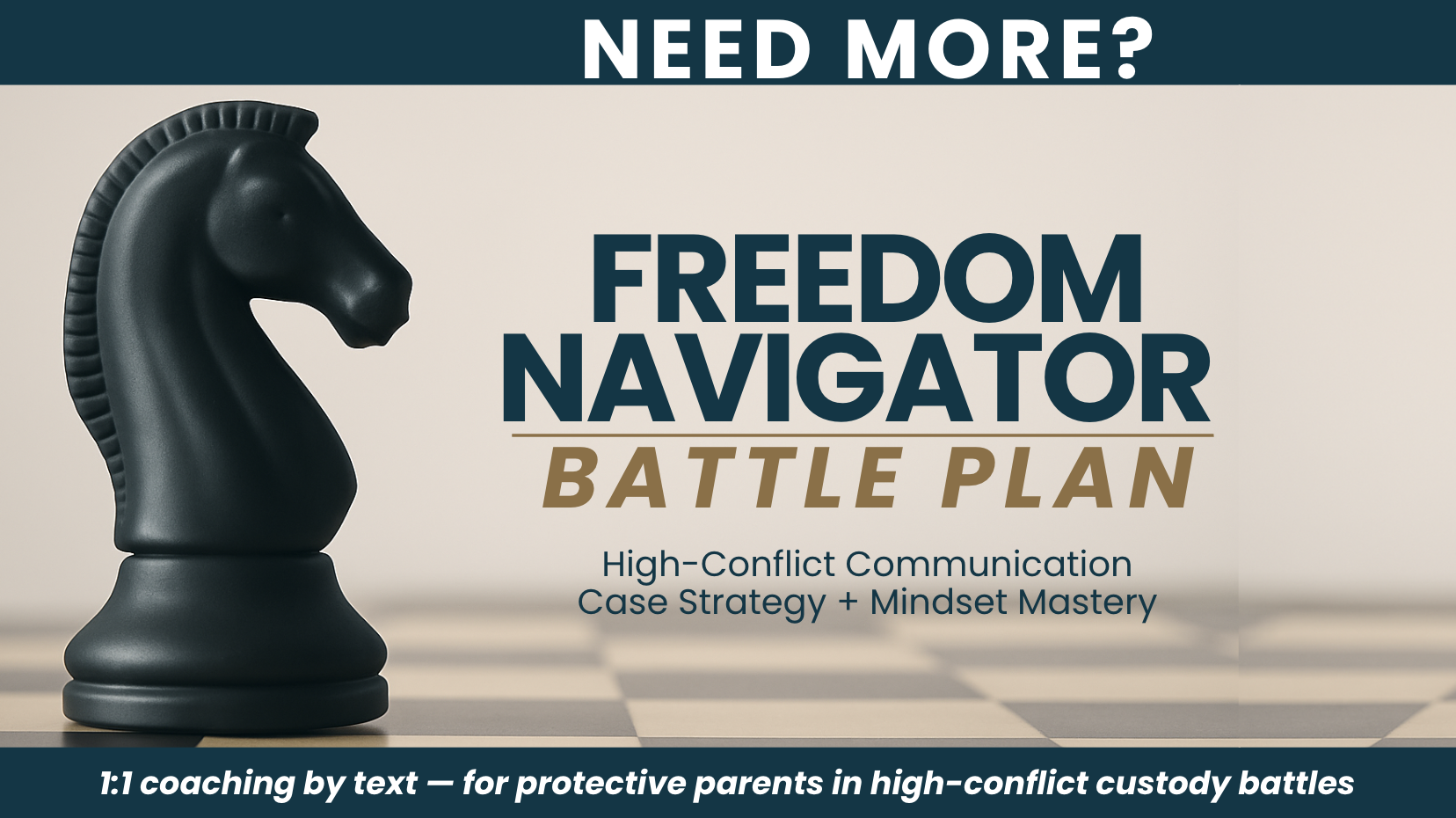
When risk indicators point toward prolonged conflict, manipulation, or post-separation abuse, personalized strategy support can make a meaningful difference.
BATTLE PLAN offers application-only, encrypted, asynchronous coaching, specifically for parents who need a communication strategist in their pocket as situations evolve, helping you think clearly and act deliberately under pressure.
There is no “right” order, and no gold star for pushing harder than your nervous system can handle.
You’re allowed to gather tools before things get hard.
And it's wise to choose support that fits your reality—not everyone else’s expectations.
Navigating your way to freedom happens one grounded step at a time.
And this next step is about choosing support that helps you reclaim your power and protect your peace as you go.